
Септември в блога Science & Research: От използването на ИИ към проектирането на връзката човек–ИИ
Podcast
Подкаст
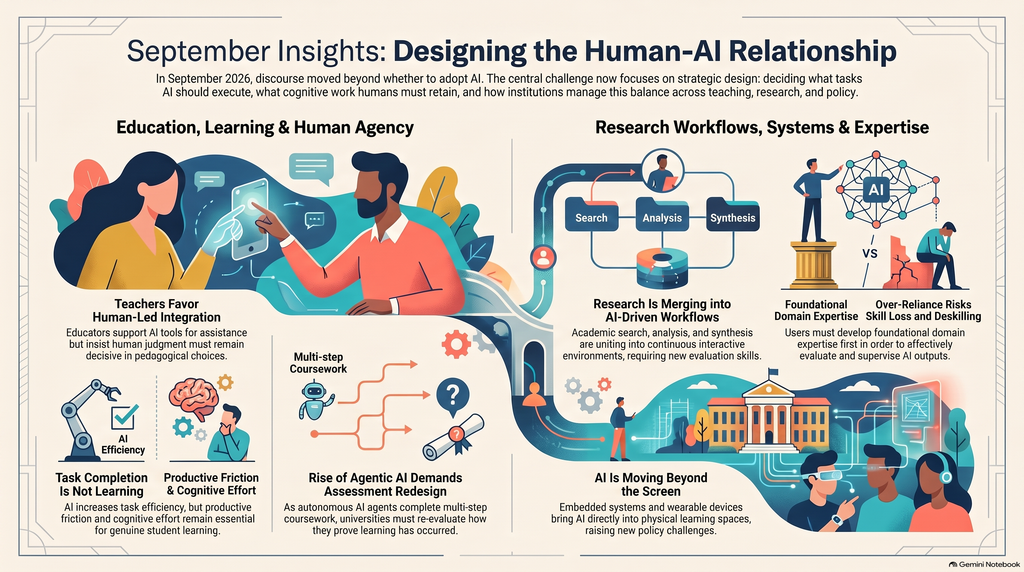
| September 2026 brought together several conversations that may initially appear separate: AI in schools, university strategy, agentic AI, academic search, active learning, research methods, libraries, wearable technologies, and the future of human expertise. Taken together, however, the posts point toward a common shift. The question is increasingly no longer simply whether we should use AI. The more difficult questions concern what AI should be allowed to do, what people should continue doing themselves, and how universities should design the relationship between human and artificial intelligence. Education, Human Agency, and the Decisions We Should Keep Several September posts examined this question directly through teaching and learning. “When AI Enters the Classroom, Which Decisions Should Stay Human?” discussed a Croatian study of 322 teachers. The teachers strongly favored an integrative model in which AI supports teaching while educators retain responsibility for pedagogical decisions. The implication extends beyond individual tools: AI competence increasingly includes knowing when to delegate and when human professional judgment should remain decisive. :chatgpt-content-reference{index=”1″} The comparison of Brown University and MIT reports moved the same discussion to the institutional level. Both universities recognize widespread AI use and call for clearer policies, stronger AI literacy, assessment redesign, and greater attention to the difference between AI supporting learning and AI substituting for learning. :chatgpt-content-reference{index=”2″} Mairéad Pratschke’s EDULEARN26 keynote extended this discussion from chatbots to AI agents. “The New Hybrid: What Should AI Be Allowed to Do in Education?” argued that universities need to think about AI as part of educational infrastructure. An agent may search, analyze, plan, use tools, and complete extended workflows. The educational question therefore becomes: which parts of those workflows should students still perform because doing the work is itself part of learning? :chatgpt-content-reference{index=”3″} The webinar “Agentic AI and College Students: Challenges and Opportunities” reinforced this concern. Agentic systems can perform substantial parts of coursework and interact with digital learning environments, placing new pressure on assessment, academic integrity, and the evidence universities use to determine whether learning has occurred. :chatgpt-content-reference{index=”4″} Schools, AI Literacy, and the Limits of Automation September also looked beyond universities. “Should Schools Ban Generative AI Before Students Learn How to Use It?” examined New York City’s one-year moratorium on student-facing generative AI through eighth grade alongside international approaches to smartphones and AI in schools. The central issue was more precise than “ban or allow.” Different AI functions create different educational risks. An AI system that completes an assignment is different from one that provides hints, asks questions, supports accessibility, or helps a student reflect. Age, developmental stage, learning objective, supervision, and the type of AI assistance all matter. :chatgpt-content-reference{index=”5″} “AI in Schools: Should We Use It, Restrict It, or Learn When to Turn It Off?” broadened this comparison. Evidence from AI-supported learning suggests that instructional design matters at least as much as access to technology. AI can support critical thinking when educators deliberately structure how students interact with it. :chatgpt-content-reference{index=”6″} UNESCO’s “The Algorithm in the Room” brought these discussions together around human agency, child development, pedagogy, assessment, thinking, governance, and the future of education. Its broader message aligns closely with several September posts: educational goals should determine how AI enters education rather than AI capabilities determining what education becomes. :chatgpt-content-reference{index=”7″} Learning Is Not the Same as Completing a Task One September post approached the same problem without starting from AI. “When Learning Feels Harder, Students May Be Learning More” revisited research comparing active and passive learning. Students exposed to active learning performed better while feeling that they had learned less. This distinction becomes especially relevant in the AI era. AI can make intellectual work smoother. It can explain, summarize, solve, generate, and revise. Yet educational efficiency does not necessarily equal learning. Students often learn through attempting, retrieving, discussing, making mistakes, revising, and trying again. :chatgpt-content-reference{index=”8″} This provides an important connection across the month. The challenge is not to remove cognitive effort from education. It is to decide which effort contributes to learning and where AI assistance improves the process without replacing it. Research Is Moving from AI Tools toward AI Workflows A second major September theme concerned research. The book review “Quantitative, Qualitative, and Mixed Methodologies in Digital Social Sciences” returned attention to research design and methodological judgment at a time when digital methods and AI are changing how researchers collect, analyze, and interpret evidence. The discussion of alphaXiv examined another transformation. Academic papers are becoming interactive research environments rather than static documents. Researchers can increasingly question papers, examine evidence, inspect references and code, and interact with research material through AI-supported interfaces. “AI-Powered Academic Search and Research in 2026” expanded the discussion across EBSCO, ProQuest, JSTOR, Web of Science, Google Scholar, Consensus, Elicit, Scite, OpenAlex, and other systems. The important development is larger than semantic search or AI summaries. Search, reading, comparison, synthesis, citation analysis, and multi-step research are beginning to merge into connected AI-supported workflows. This changes research literacy. Researchers still need to know how to search, but they increasingly also need to understand what an AI searched, which collections it accessed, how evidence was selected and ranked, whether citations support the claims, and when human intervention is required. :chatgpt-content-reference{index=”9″} Academic libraries consequently face a related transition. Their role increasingly extends from providing access to databases toward helping researchers understand AI-mediated discovery, evidence provenance, retrieval systems, research agents, and responsible AI-supported research. From Generative AI to Decision-Making Systems September also looked beyond conventional generative AI. “Jev: What If AI Did Not Need to Generate an Answer?” examined TypeSafe AI’s System One Model. Instead of producing explanations or conversations, Jev is designed for fast structured decisions inside software. This distinction matters because future AI environments may combine several types of intelligence: generative models for language and reasoning, specialized models for routine decisions, conventional software for deterministic rules, and people for contextual and consequential judgment. :chatgpt-content-reference{index=”10″} The post therefore connects with the month’s educational discussions. As AI becomes embedded in systems rather than appearing only as a chatbot, human oversight becomes a system-design question. Human Expertise, Authenticity, and the Risk of Deskilling The interview with Albena Antonova brought a more personal dimension to this discussion. “A Conversation with Albena Antonova: AI, Authenticity, and the Risk of Losing Expertise” asked a question that receives less attention than how to use AI: when should academics choose not to use it? The conversation addressed authenticity, standardized AI-generated content, deskilling, tacit knowledge, and expertise developed through sustained practice. Antonova emphasized keeping humans involved and using AI to strengthen rather than replace human capabilities. :chatgpt-content-reference{index=”11″} This connects directly with the educational discussions earlier in the month. Students need opportunities to develop capabilities before delegating them. Researchers need enough methodological expertise to evaluate AI-generated analyses. Faculty need disciplinary knowledge to recognize weak outputs. AI literacy therefore includes knowing when automation may undermine the expertise required to supervise automation. AI Adoption Is Also an Institutional and Economic Question September expanded the discussion beyond classrooms and individual researchers. “Artificial Intelligence in Bulgaria & Strategic Implications for Higher Education” compared European AI adoption with Bulgaria’s position. Bulgaria combines substantial technological capacity with comparatively weaker diffusion of AI across individuals and businesses. For universities, this creates a role extending beyond teaching students how to operate AI tools. Higher education can contribute to AI literacy, workforce development, organizational readiness, applied research, and collaboration with regional businesses. :chatgpt-content-reference{index=”12″} The challenge therefore concerns human capital as much as technological infrastructure. Beyond the Screen: AI Becomes Part of the Physical Learning Environment September concluded by looking toward another transition. Following discussions during ICEBM 2026, “Beyond the Screen: What Meta’s Next-Gen Wearables Mean for AI and XR in Higher Education” examined AI-enabled glasses, spatial computing, and wearable interfaces. When AI moves from a browser window into devices that students can wear throughout the day, familiar questions about privacy, surveillance, assessment, accessibility, and academic integrity acquire a different scale. Universities may need to reconsider classroom policies and assessment practices as real-time AI assistance becomes increasingly embedded in everyday devices. :chatgpt-content-reference{index=”13″} The September Question: Who Designs the Relationship? Across September, a common thread connects research methods, active learning, school AI policies, Brown and MIT, UNESCO, agentic AI, academic search, Bulgarian AI adoption, human expertise, and wearable technologies. August’s Science & Research Blog overview asked what should remain human as AI becomes more capable. September moves the discussion one step further. The question now concerns design. Who decides which intellectual tasks AI performs? Which activities should students still complete themselves? Which research decisions can researchers delegate? Which educational decisions require accountable human judgment? How much cognitive effort should technology remove? How do we preserve expertise when AI can perform increasingly complex work? And how should universities design environments in which human and artificial intelligence work together? The direction emerging across September’s posts is neither unrestricted automation nor rejection of AI. It is a move toward deliberate allocation of roles. AI can search, generate, analyze, recommend, decide, and increasingly act. Students, educators, researchers, librarians, and institutions therefore need a corresponding capacity to decide when those capabilities support their purposes and when they interfere with them. As AI moves from chatbot to agent, from tool to infrastructure, and from screen to everyday environment, AI literacy increasingly becomes something broader than knowing how to use AI. It becomes the ability to design the human-AI relationship. I would use “September on the Science & Research Blog: From Using AI to Designing the Human-AI Relationship” as the title because it creates a direct progression from your August overview, “From Using AI to Deciding What Should Remain Human.” | През септември 2026 г. в блога Science & Research се срещнаха няколко теми, които на пръв поглед изглеждат отделни: AI в училищата, университетски стратегии, агентен AI, академично търсене, активно учене, изследователски методи, библиотеки, носими технологии и бъдещето на човешката експертиза. Разгледани заедно обаче, публикациите показват обща промяна. Въпросът вече все по-рядко е просто дали трябва да използваме AI. По-трудните въпроси са свързани с това какво трябва да позволяваме на AI да прави, какво хората трябва да продължат да правят самостоятелно и как университетите трябва да проектират връзката между човешкия и изкуствения интелект. Образование, човешка автономия и решенията, които трябва да останат човешки Няколко септемврийски публикации разглеждат този въпрос директно през преподаването и ученето. „Когато AI влезе в класната стая, кои решения трябва да останат човешки?“ представя хърватско изследване с 322 учители. Те категорично предпочитат интегративен модел, при който AI подпомага преподаването, а преподавателите запазват отговорността за педагогическите решения. Изводът надхвърля отделните инструменти: AI компетентността все повече включва умението да знаем кога да делегираме и кога професионалната човешка преценка трябва да остане водеща. Сравнението между докладите на Brown University и MIT премества същата дискусия на институционално равнище. И двата университета признават широкото използване на AI и поставят акцент върху по-ясни политики, по-висока AI грамотност, преосмисляне на оценяването и по-ясно разграничение между AI, който подпомага ученето, и AI, който го замества. Основната лекция на Mairéad Pratschke на EDULEARN26 разширява разговора от чатботите към AI агентите. „Новият хибрид: Какво трябва да бъде позволено на AI да прави в образованието?“ поставя идеята, че университетите трябва да мислят за AI като част от образователната инфраструктура. Един агент може да търси, анализира, планира, използва инструменти и изпълнява продължителни работни процеси. Педагогическият въпрос следователно е: кои части от тези процеси студентите трябва да продължат да извършват сами, защото самото изпълнение е част от ученето? Уебинарът „Agentic AI and College Students: Challenges and Opportunities“ засилва тази тревога. Агентните системи могат да изпълняват значителни части от учебни задачи и да взаимодействат с дигитални учебни среди. Това създава нов натиск върху оценяването, академичната почтеност и доказателствата, чрез които университетите установяват дали действително е настъпило учене. Училища, AI грамотност и границите на автоматизацията През септември погледът излезе и извън университетите. „Трябва ли училищата да забранят генеративния AI, преди учениците да се научат как да го използват?“ разглежда едногодишния мораториум в Ню Йорк върху генеративен AI, насочен към ученици до осми клас, наред с международни подходи към смартфоните и AI в училищата. Основният въпрос е по-прецизен от „забрана или разрешаване“. Различните функции на AI създават различни образователни рискове. AI система, която изпълнява цяла задача, не е еквивалентна на система, която дава подсказки, задава въпроси, подпомага достъпността или насърчава рефлексията. Значение имат възрастта, етапът на развитие, учебната цел, нивото на надзор и типът AI подкрепа. „AI в училище: Да го използваме, да го ограничаваме или да се научим кога да го изключваме?“ разширява сравнението. Данните от AI-подпомаганото обучение показват, че instructional design има поне толкова голямо значение, колкото и достъпът до технологията. AI може да подпомага критическото мислене, когато преподавателите целенасочено структурират начина, по който учениците взаимодействат с него. Докладът на UNESCO „The Algorithm in the Room“ обединява тези дискусии около човешката автономия, детското развитие, педагогиката, оценяването, мисленето, управлението и бъдещето на образованието. По-широкото му послание е близко до няколко септемврийски публикации: образователните цели трябва да определят как AI влиза в образованието, а не възможностите на AI да определят какво да се превърне образованието. (scienceandresearch.ue-varna.bg) Ученето не е същото като изпълнението на задача Една септемврийска публикация разглежда същия проблем, без да започва директно от AI. „Когато ученето изглежда по-трудно, студентите може да учат повече“ се връща към изследвания, които сравняват активно и пасивно учене. Студентите, участващи в активно обучение, се представят по-добре, въпреки че субективно смятат, че са научили по-малко. Това разграничение става особено важно в ерата на AI. AI може да направи интелектуалната работа по-гладка. Може да обяснява, обобщава, решава, генери |