
От ИИ турсене към изследователска преценка: Katina и OpenaAlex
Podcast
Подкаст
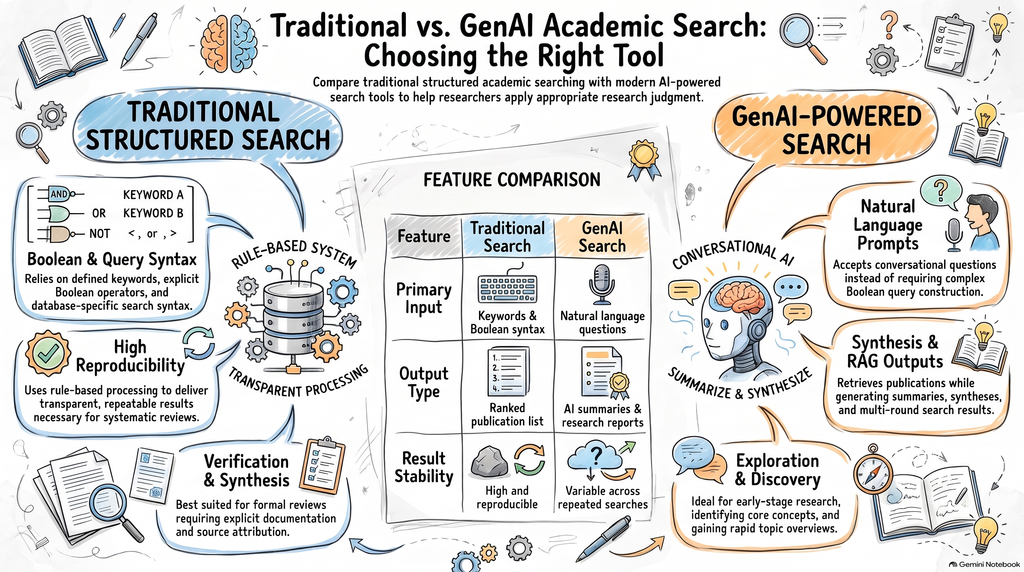
| Academic search is changing. For years, researchers learned a familiar process: define a question, choose databases, identify keywords, build a search strategy, review results, and evaluate the literature. Artificial intelligence is adding new layers to this process. Some academic search tools now interpret natural-language questions, rank papers by estimated relevance, summarize publications, and even generate research reports. At the same time, platforms such as OpenAlex are improving another part of research: structured and reproducible searching. A recent article in Katina Magazine by Aaron Tay, together with new OpenAlex search features, shows why researchers now need to understand both approaches. THE FIRST CHANGE: AI SEARCH IS NOT ONE THING One of the most useful ideas in the Katina article is a simple framework for understanding AI-supported academic search. – Some tools mainly find papers. – Others find papers and generate answers from them. – Some perform a quick search. – Others conduct several rounds of searching before producing results. This creates four broad types of academic search: – Quick search finds and ranks publications. – Deep search conducts several rounds of searching to identify more relevant publications. – Quick RAG retrieves papers and produces an AI-generated answer based on them. – Deep research combines repeated searching with a longer AI-generated synthesis. This distinction is important. A student after several good papers on a topic has different needs from a researcher conducting a systematic review. Someone entering a new research area may benefit from an AI-generated overview. Someone else preparing a review for publication needs a transparent search process so another researcher can understand and repeat. AI search tools should therefore be selected according to the research task. THE SECOND CHANGE: FINDING RELEVANT PAPERS IS NOT ENOUGH AI search systems often make research feel easier due to the natural language researchers can use to ask questions. Instead of constructing a long Boolean query, we can ask: “What does recent research say about generative AI and student learning?” The system may return relevant studies and summarize their findings. This is useful, especially during the early stages of research. But it raises new questions. – What literature does the tool cover? – How does it decide which papers are relevant? – Why does one paper appear before another? – Would another researcher receive the same results? – Did the AI summarize the studies correctly? These questions are central to Aaron Tay’s Katina article. His tests alert us: different AI search tools can produce different levels of stability when the same search is repeated. Some results may remain relatively stable, while others may change. For exploratory research, this may be acceptable. For evidence synthesis, systematic reviews, and research intended for publication, reproducibility is more important. THE OPENALEX APPROACH IS DIFFERENT OpenAlex addresses another part of the problem. Researchers often develop complex search strategies in databases such as Scopus, Web of Science, PubMed, Ovid, Embase, Cochrane Library, or EBSCO. Each database has its own search language. A search applicable in Scopus cannot simply be copied into Web of Science or PubMed. OpenAlex now provides tools for translating search strategies from several major databases into OpenAlex Query Language, or OQL. Sounds technical? Here the simple explanation: A researcher can take an existing structured search and convert it into a form for OpenAlex to understand. The system can handle Boolean operators, fields, proximity searching, and even some numbered multi-line search strategies. Aaron Tay highlighted this development in his comments, describing OpenAlex as increasingly important when conducting evidence synthesis. An important feature to remember: the translation to OQL is rule based. It does not depend on a language model interpreting what the researcher might have intended. This makes the process easier to inspect and document. TRANSLATION DOES NOT MEAN IDENTICAL RESULTS An important limitation. A search translated from one database into another will not automatically produce the same results. Databases differ in coverage, indexing, keywords, subject headings, document types, and search fields. For example, PubMed uses MeSH controlled vocabulary. Scopus has its own indexing structure. OpenAlex uses its own metadata and concepts. Bottomline: a translated search needs to be checked. Researchers should ask: – Does the translated search retrieve important papers we already know? – Are important journals or disciplines missing? – Did any part of the original search logic change? – This is why OpenAlex should be seen as a research tool that supports search strategy development, rather than as an automatic replacement for specialized databases. LAURA EGAN ADDS AN IMPORTANT LIBRARY PERSPECTIVE Academic librarian Laura Egan raises another issue. Faculty responses to AI vary widely. Some instructors tell students not to use AI. Others encourage extensive use. But researchers and students need something more useful than a simple choice between “use AI” and “do not use AI.” They need to understand the working of research tools. Ask these questions: – What does the resource cover? – How does it retrieve information? – How does it rank results? – Would another researcher receive similar results? These questions apply to traditional databases and AI search systems. Laura also emphasizes a principle central to academic work: – The author is responsible for the final content. – If an AI system provides a reference, the researcher should check the source. – If it summarizes a study, the researcher should compare the summary with the original publication. – If it presents one interpretation, the researcher should consider whether other interpretations or contradictory evidence exist. FROM SEARCH SKILLS TO SEARCH JUDGMENT These developments suggest an imminent need for academic search instruction to change. Students still need to learn keywords, Boolean operators, databases, citation searching, and controlled vocabulary. But they also need new skills. – They need to understand the difference between retrieval and synthesis. – They must learn to recognize a fluent AI answer is not the same as verified evidence. – They need to compare tools rather than depend on one system. – And they need to document the process of their search. A useful research workflow might look like this: – Start with AI-assisted search to explore the topic and identify important concepts. – Develop a structured search strategy based on what you learn. – Search appropriate academic databases. – Translate and test the strategy in OpenAlex when useful. – Compare results across systems. – Read and verify the original publications. – Use AI to support analysis and synthesis, while keeping the researcher responsible for interpretation. THE MAIN LESSON The future of academic search is not simply “AI replacing databases.” We are seeing two developments at the same time. AI tools are making academic search more conversational and more capable of generating summaries and syntheses. Platforms such as OpenAlex are making structured academic searching more open, transferable, and potentially more reproducible. Both are useful. They solve different problems. For students, faculty, librarians, and doctoral researchers, the central skill remains the acquisition of research judgment. The important question is no longer only: “Can this tool find papers for me?” We also need to ask: “How did it find them, what might it have missed, can I verify the results, and can I explain my search process to someone else?” Academic search is moving from finding information toward understanding and documenting how evidence is found, evaluated, and used. | Академичното търсене се променя. В продължение на години изследователите следваха познат процес: формулиране на въпрос, избор на бази данни, определяне на ключови думи, изграждане на стратегия за търсене, преглед на резултатите и оценка на литературата. Изкуственият интелект добавя нови нива към този процес. Някои инструменти за академично търсене вече интерпретират въпроси на естествен език, подреждат публикациите по предполагаема релевантност, обобщават научни трудове и дори генерират изследователски доклади. В същото време платформи като OpenAlex подобряват друга част от изследователския процес: структурираното и възпроизводимо търсене. Скорошна статия на Aaron Tay в Katina Magazine, заедно с новите възможности за търсене в OpenAlex, показва защо изследователите вече трябва да разбират и двата подхода. ПЪРВАТА ПРОМЯНА: AI ТЪРСЕНЕТО НЕ Е ЕДНО И СЪЩО НЕЩО Една от най-полезните идеи в статията на Katina е проста рамка за разбиране на академичното търсене с помощта на AI. Някои инструменти основно намират научни публикации. Други намират публикации и генерират отговори въз основа на тях. Някои извършват бързо търсене. Други провеждат няколко последователни кръга на търсене, преди да представят резултати. Това създава четири основни типа академично търсене: Quick search намира и подрежда публикации. Deep search извършва няколко кръга на търсене, за да открие по-релевантни публикации. Quick RAG извлича публикации и генерира AI отговор въз основа на тях. Deep research комбинира многократно търсене с по-обширен AI генериран синтез. Тази разлика е важна. Студент, който търси няколко добри публикации по дадена тема, има различни нужди от изследовател, който провежда систематичен преглед. Човек, който навлиза в нова изследователска област, може да има полза от AI генериран обзор. Изследовател, който подготвя обзор за публикация, се нуждае от прозрачен процес на търсене, който друг изследовател може да разбере и повтори. Затова AI инструментите за търсене трябва да се избират според конкретната изследователска задача. ВТОРАТА ПРОМЯНА: ДА НАМЕРИМ РЕЛЕВАНТНИ ПУБЛИКАЦИИ НЕ Е ДОСТАТЪЧНО AI системите за търсене често правят изследователския процес по-лесен, защото позволяват на изследователите да задават въпроси на естествен език. Вместо да създаваме дълга Boolean заявка, можем да попитаме: „Какво показват последните изследвания за генеративния AI и ученето на студентите?“ Системата може да върне релевантни изследвания и да обобщи техните резултати. Това е полезно, особено в началните етапи на изследването. Но възникват нови въпроси. Каква литература обхваща инструментът? Как решава кои публикации са релевантни? Защо една публикация се появява преди друга? Ще получи ли друг изследовател същите резултати? AI правилно ли е обобщил изследванията? Тези въпроси са в центъра на статията на Aaron Tay в Katina. Неговите тестове ни предупреждават: различните AI инструменти за търсене могат да показват различна степен на стабилност при повторение на една и съща заявка. Някои резултати могат да останат сравнително стабилни, докато други могат да се променят. За предварително, изследователско търсене това може да е приемливо. При синтез на доказателства, систематични прегледи и изследвания, предназначени за публикация, възпроизводимостта е много по-важна. ПОДХОДЪТ НА OPENALEX Е РАЗЛИЧЕН OpenAlex разглежда друга част от проблема. Изследователите често разработват сложни стратегии за търсене в бази данни като Scopus, Web of Science, PubMed, Ovid, Embase, Cochrane Library или EBSCO. Всяка база данни има собствен език за търсене. Заявка, приложима в Scopus, не може просто да бъде копирана в Web of Science или PubMed. OpenAlex вече предлага инструменти за превеждане на стратегии за търсене от няколко големи бази данни към OpenAlex Query Language, или OQL. Звучи технически? Ето простото обяснение: Изследователят може да вземе вече съществуващо структурирано търсене и да го преобразува във форма, която OpenAlex разбира. Системата може да обработва Boolean оператори, полета, proximity searching и дори някои номерирани многостъпкови стратегии за търсене. Aaron Tay подчертава това развитие в своите коментари, като определя OpenAlex като все по-важен инструмент при синтез на доказателства. Важно е да се помни: преводът към OQL е базиран на правила. Той не зависи от езиков модел, който да интерпретира какво може би е имал предвид изследователят. Това прави процеса по-лесен за проверка и документиране. ПРЕВОДЪТ НЕ ОЗНАЧАВА ИДЕНТИЧНИ РЕЗУЛТАТИ Има важно ограничение. Търсене, преведено от една база данни към друга, няма автоматично да доведе до същите резултати. Базите данни се различават по обхват, индексиране, ключови думи, предметни рубрики, видове документи и полета за търсене. Например PubMed използва контролираната терминология MeSH. Scopus има собствена структура на индексиране. OpenAlex използва собствени метаданни и концепции. Основният извод: преведеното търсене трябва да бъде проверено. Изследователите трябва да попитат: Открива ли преведеното търсене важни публикации, които вече познаваме? Липсват ли важни списания или научни области? Променила ли се е някоя част от логиката на първоначалното търсене? Затова OpenAlex трябва да се разглежда като изследователски инструмент, който подпомага разработването на стратегии за търсене, а не като автоматичен заместител на специализираните бази данни. LAURA EGAN ДОБАВЯ ВАЖНАТА ГЛЕДНА ТОЧКА НА АКАДЕМИЧНАТА БИБЛИОТЕКА Академичният библиотекар Laura Egan поставя още един въпрос. Нагласите на преподавателите към AI се различават значително. Някои казват на студентите да не използват AI. Други насърчават широкото му използване. Но изследователите и студентите имат нужда от нещо по-полезно от простия избор между „използвай AI“ и „не използвай AI“. Те трябва да разбират как работят изследователските инструменти. Задавайте следните въпроси: Какво обхваща ресурсът? Как извлича информация? Как подрежда резултатите? Ще получи ли друг изследовател сходни резултати? Тези въпроси се отнасят както за традиционните бази данни, така и за AI системите за търсене. Laura подчертава и принцип, който остава централен за академичната работа: Авторът носи отговорност за крайното съдържание. Ако AI система предостави източник, изследователят трябва да го провери. Ако AI обобщи изследване, изследователят трябва да сравни обобщението с оригиналната публикация. Ако AI представи една интерпретация, изследователят трябва да провери дали съществуват други интерпретации или противоречащи доказателства. ОТ УМЕНИЯ ЗА ТЪРСЕНЕ КЪМ ИЗСЛЕДОВАТЕЛСКА ПРЕЦЕНКА Тези промени показват, че обучението по академично търсене трябва да се промени. Студентите все още трябва да изучават ключови думи, Boolean оператори, бази данни, цитатно търсене и контролирана терминология. Но те също така се нуждаят от нови умения. Трябва да разбират разликата между извличане на информация и синтез. Трябва да се научат да разпознават, че гладко формулираният AI отговор не е равнозначен на проверено доказателство. Трябва да сравняват различни инструменти, вместо да зависят от една система. Трябва да документират процеса на своето търсене. Един полезен изследователски процес може да изглежда така: Започнете с AI подпомогнато търсене, за да изследвате темата и да определите важните понятия. Разработете структурирана стратегия за търсене въз основа на наученото. Търсете в подходящи академични бази данни. Когато е полезно, преведете и тествайте стратегията в OpenAlex. Сравнете резултатите между различните системи. Прочетете и проверете оригиналните публикации. Използвайте AI за подпомагане на анализа и синтеза, като изследователят запазва отговорността за интерпретацията. ОСНОВНИЯТ ИЗВОД Бъдещето на академичното търсене не е просто „AI заменя базите данни“. Наблюдаваме две промени едновременно. AI инструментите правят академичното търсене по-разговорно и все по-способно да генерира обобщения и синтези. Платформи като OpenAlex правят структурираното академично търсене по-отворено, по-лесно за пренасяне между различни системи и потенциално по-възпроизводимо. И двата подхода са полезни. Те решават различни проблеми. За студентите, преподавателите, библиотекарите и докторантите централното умение остава изграждането на изследователска преценка. Важният въпрос вече не е само: „Може ли този инструмент да намери публикации вместо мен?“ Трябва да питаме и: „Как ги намери, какво може да е пропуснал, мога ли да проверя резултатите и мога ли да обясня процеса на търсене на друг човек?“ Академичното търсене се измества от простото намиране на информация към разбирането и документирането на начина, по който доказателствата се откриват, оценяват и използват. |
Further in this blog:
- AI-Powered Academic Search and Research in 2026: What Changed in August, What the New Features Do, and Why the Database Model Is Changing
This is the closest earlier post. It examines EBSCO, ProQuest, JSTOR, Web of Science, Google Scholar, Consensus, Elicit, Scite, OpenAlex, and related systems. Its main argument is similar to the new post: academic search is moving from a database-centered model toward integrated workflows combining search, reading, comparison, synthesis, and citation analysis. Science and Research
Connection to the new post:
The September article describes the broader transformation. The Katina/OpenAlex post adds a more precise distinction between AI-based retrieval and synthesis, on one side, and structured, reproducible searching with OpenAlex, on the other.
- Why One Search Bar Is Never Enough: Lessons in AI Literature Research
This post provides a strong practical complement. It discusses tests comparing OpenAlex semantic search, Consensus API, and Consensus Pro. Only one paper appeared across all three result sets in the reported comparison. Science and Research
Connection to the new post:
Both posts challenge the idea that one search system can provide a complete picture of the literature. The new article explains why this happens, different systems have different coverage, ranking, retrieval logic, and search strategies. Together they support a blended search approach.
- From Google Scholar to ChatGPT Study Mode: Lessons from Librarians for AI in Education
This earlier post also draws on Aaron Tay. It examines what the history of Google Scholar can teach us about current AI research tools, particularly problems with transparency, metadata, search control, and unclear coverage. Science and Research
Connection to the new post:
The new article continues the same argument. A convenient interface does not remove the need to understand how a search system works. The comparison between Katina and OpenAlex makes this issue more concrete by adding reproducibility and search-strategy translation.
- How Librarians Are Redesigning Research in the Age of AI
This post contrasts established academic research systems based on databases, controlled vocabularies, and structured search with newer AI tools based on natural-language interaction. It places librarians between these two approaches. Science and Research
Connection to the new post:
Laura Egan’s comments fit directly into this earlier discussion. Librarians increasingly need to teach students and researchers how to evaluate coverage, retrieval, ranking, reproducibility, and source verification rather than teaching database syntax alone.
- When AI Becomes the Research Assistant: Why the TRACE Project Matters for Academic Libraries
This post examines what happens when AI systems become intermediaries between researchers and scholarly publications. TRACE focuses on provenance, attribution, access, and the ability to trace AI-generated answers back to original research. Science and Research
Connection to the new post:
The Katina/OpenAlex article asks whether researchers can understand and reproduce how evidence was found. TRACE asks a closely related question: can researchers trace AI-generated information back to the scholarly sources supporting it? Both place transparency and verification at the center of responsible AI-supported research.
- September on the Science & Research Blog: From Using AI to Designing the Human-AI Relationship
This monthly overview connects academic search with a broader question about the division of work between researchers and AI. It notes that researchers increasingly need to understand what AI searched, which collections it accessed, how evidence was ranked, whether citations support claims, and when human intervention is required. Science and Research
Connection to the new post:
The new article provides a practical example of this human-AI relationship. AI can assist with discovery and synthesis, while researchers retain responsibility for designing searches, checking coverage, verifying publications, and interpreting evidence.
For the new Katina/OpenAlex article, I would highlight these four as the most directly related:
• AI-Powered Academic Search and Research in 2026, for the broader transformation of academic search.
• Why One Search Bar Is Never Enough, for the argument that researchers need multiple search systems.
• How Librarians Are Redesigning Research in the Age of AI, for Laura Egan’s library and research-literacy perspective.
• When AI Becomes the Research Assistant, for verification, provenance, and traceability.
Together, these posts form a clear progression in the blog: from AI-powered search, to comparing search systems, to understanding their limitations, and finally to a stronger emphasis on transparent, reproducible, and accountable research.