
Отвъд писането на промптове: Защо критичната ИИ грамотност е важна за преподавателите и студентите?
Link to analysis of the document here
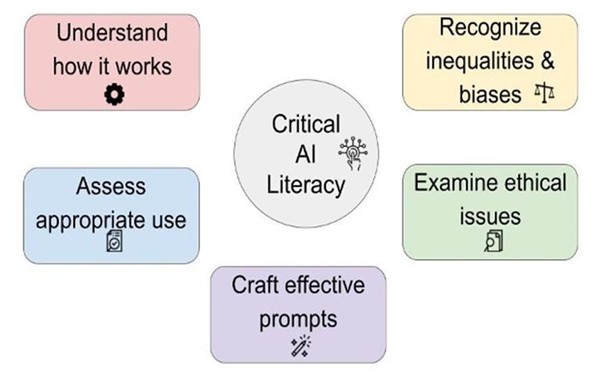
| Artificial intelligence is becoming part of everyday academic life. Students use ChatGPT, Claude, Gemini, and other AI tools to understand concepts, summarize readings, prepare assignments, and conduct research. Faculty use the same technologies to develop teaching materials, design assessments, analyze data, and support academic writing. But knowing how to operate an AI tool does not necessarily mean understanding how to evaluate its responses, recognize its limitations, or make responsible decisions about its use. This distinction is at the center of A Framework for the Learning and Teaching of Critical AI Literacy Skills, published by The Open University (OU) in spring 2025. Developed by Mirjam Hauck, Eleanor Moore, and Carol Wright, with Mike Sharples as adviser, the framework offers a practical approach to developing AI competencies across university disciplines. Its main message is straightforward: AI literacy must go beyond learning how to use AI. It must include learning when to question AI, how to evaluate its outputs, and how to understand its consequences for individuals and society. What Makes Critical AI Literacy Different? Traditional digital literacy focuses on finding, evaluating, creating, and communicating information using digital technologies. AI literacy introduces additional competencies, including understanding how AI systems work, communicating with them effectively, and recognizing their limitations. Critical AI Literacy goes further. It examines how AI systems influence knowledge, human agency, inclusion, and social relationships. For example, a student might know how to ask ChatGPT to produce a marketing analysis. But can the student identify unsupported claims, verify the data, or recognize cultural stereotypes in the recommendations? Similarly, a faculty member might use AI to develop an assessment. But does the assessment encourage independent thinking, or does it inadvertently reward students for generating polished answers without understanding the subject? The OU framework places equality, diversity, inclusion, and accessibility (EDIA) at the center of these questions. The authors argue that responsible AI education must consider whose perspectives AI represents, whose voices it excludes, and how AI might reinforce existing inequalities. Six Dimensions of Critical AI Literacy The framework identifies six interconnected areas of competence. 1. AI Concepts and Applications Students and faculty should understand fundamental AI concepts, distinguish between traditional and generative AI, and recognize the capabilities and limitations of different applications. This includes understanding concepts such as machine learning, large language models, hallucinations, and bias. 2. Learning and Teaching with AI AI should support learning rather than replace intellectual engagement. Instead of accepting the first AI-generated answer, students should interact with AI iteratively, ask follow-up questions, verify information, and reflect on what they have learned. Faculty can design activities where students compare AI explanations with academic sources and identify errors or omissions. 3. AI Creativity AI can support brainstorming, writing, visual communication, and problem-solving. Yet creativity requires evaluation and human judgment. For example, marketing students might generate several advertising concepts using AI, compare their cultural assumptions, and revise them for different audiences. 4. AI Ethics Responsible AI use requires attention to privacy, security, intellectual property, misinformation, and algorithmic bias. Students and faculty should understand why uploading personal information to an AI platform creates risks and why AI-generated references or claims require verification. 5. AI in Society The framework encourages examination of AI’s broader consequences, including environmental sustainability, digital inequality, labor conditions, and the concentration of technological power. For example, students might examine whether AI-based recruitment systems discriminate against certain applicants or whether access to paid AI tools creates educational disadvantages. 6. AI Careers AI competencies increasingly influence professional practice. The framework connects technical proficiency with transferable human skills such as creativity, communication, collaboration, empathy, and decision-making. Students should learn to work with AI while retaining responsibility for interpreting evidence and making professional judgments. Why Should Faculty Use This Framework? For educators, the framework provides a structure for integrating AI literacy into existing courses without requiring every discipline to introduce a separate AI module. A finance lecturer might ask students to evaluate AI-generated investment recommendations. A tourism lecturer might investigate whether AI-generated travel information adequately considers accessibility. A management lecturer might examine bias in AI-supported recruitment. Such activities develop disciplinary knowledge alongside critical AI competencies. The framework is particularly relevant for assessment redesign. When AI can generate essays, reports, presentations, and computer code, evaluating only the final product may reveal little about students’ understanding. Faculty can instead ask students to document how they used AI, explain which recommendations they accepted or rejected, verify evidence, and justify their decisions. This approach shifts attention toward the quality of students’ reasoning, evaluation, and reflection. The framework also offers a reference for faculty professional development, helping educators identify the competencies they need to teach with AI responsibly. Why Should Students Know This Framework? Students often associate AI competence with effective prompting or familiarity with particular applications. The OU framework offers a broader perspective. A critically AI-literate student should be able to recognize unreliable information, challenge assumptions, evaluate sources, understand ethical risks, and decide when AI assistance is appropriate. Consider a student preparing a research paper. AI might help identify possible research questions, explain unfamiliar concepts, or suggest analytical approaches. But the student must still verify references, evaluate methodological choices, interpret findings, and take responsibility for the final work. These skills matter beyond university. Employers increasingly encounter AI-generated analyses and recommendations, making the ability to evaluate AI outputs relevant to professional decision-making. From AI Users to Critical AI Thinkers The OU framework also distinguishes introductory from advanced Critical AI Literacy. At an introductory level, learners develop an understanding of AI technologies, their limitations, and responsible use. At an advanced level, they examine how AI affects power relationships, inequalities, and opportunities for social change. Importantly, the framework does not prescribe a rigid sequence of lessons. It encourages faculty to incorporate relevant competencies throughout the curriculum and revisit them as AI technologies and educational practices evolve. For universities, this suggests a practical starting point: integrate critical evaluation, evidence verification, ethical reflection, and inclusive thinking into assignments where students already encounter AI. Faculty do not need to teach every technical detail of artificial intelligence. Students do not need to become AI developers. Both groups, though, need to understand how AI influences learning, knowledge, decisions, and society. The central educational question is no longer simply whether students and faculty should use AI. It is how universities can prepare people to use AI effectively while preserving independent judgment, critical thinking, and responsibility. The Open University framework offers a useful foundation for answering this question. | Изкуственият интелект все повече навлиза в ежедневния академичен живот. Студентите използват ChatGPT, Claude, Gemini и други AI инструменти, за да разбират учебния материал, да обобщават текстове, да подготвят задания и да провеждат изследвания. Преподавателите използват същите технологии за разработване на учебни материали, създаване на задания за оценяване, анализ на данни и подпомагане на академичното писане. Но умението да работим с инструмент с изкуствен интелект не означава непременно, че знаем как да оценяваме неговите отговори, да разпознаваме ограниченията му или да вземаме отговорни решения за неговото използване. Именно това разграничение е в основата на „Рамка за обучение и преподаване на умения за критична грамотност в областта на изкуствения интелект“, публикувана от The Open University (OU) през пролетта на 2025 г. Разработена от Mirjam Hauck, Eleanor Moore и Carol Wright, с участието на Mike Sharples като научен консултант, рамката предлага практически подход за развитие на AI компетентности в различни университетски дисциплини. Основното ѝ послание е ясно: AI грамотността трябва да надхвърля умението да използваме изкуствен интелект. Тя трябва да включва способността да поставяме под въпрос неговите отговори, да оценяваме генерираното съдържание и да разбираме последствията от използването му за отделните хора и обществото. С какво се отличава критичната AI грамотност? Традиционната дигитална грамотност се фокусира върху намирането, оценяването, създаването и комуникирането на информация чрез цифрови технологии. AI грамотността добавя нови компетентности, сред които разбиране на начина, по който функционират AI системите, ефективно взаимодействие с тях и разпознаване на ограниченията им. Критичната AI грамотност прави още една крачка напред. Тя разглежда как AI системите влияят върху знанието, човешката самостоятелност, приобщаването и обществените отношения. Например студент може да знае как да използва ChatGPT за изготвяне на маркетингов анализ. Но способен ли е да разпознае необоснованите твърдения, да провери данните или да установи културни стереотипи в предложените препоръки? По подобен начин преподавател може да използва AI за създаване на задание. Но насърчава ли то самостоятелното мислене, или неволно възнаграждава студентите за генерирането на добре оформени отговори, без действително да разбират учебния материал? Рамката на OU поставя равнопоставеността, многообразието, приобщаването и достъпността (Equality, Diversity, Inclusion and Accessibility, EDIA) в центъра на тези въпроси. Според авторите отговорното образование в областта на AI трябва да отчита чии гледни точки представят AI системите, кои групи остават недостатъчно представени и как технологиите могат да възпроизвеждат съществува |
Reference: Hauck, M., Moore, E., & Wright, C. (2025). A Framework for the Learning and Teaching of Critical AI Literacy Skills (Version 0.1). The Open University.