
Запознайте се с Mistral Large 4: европейският голям и „пухкав” AI флагман — и какво означава това за университетите
Podcast
Подкас
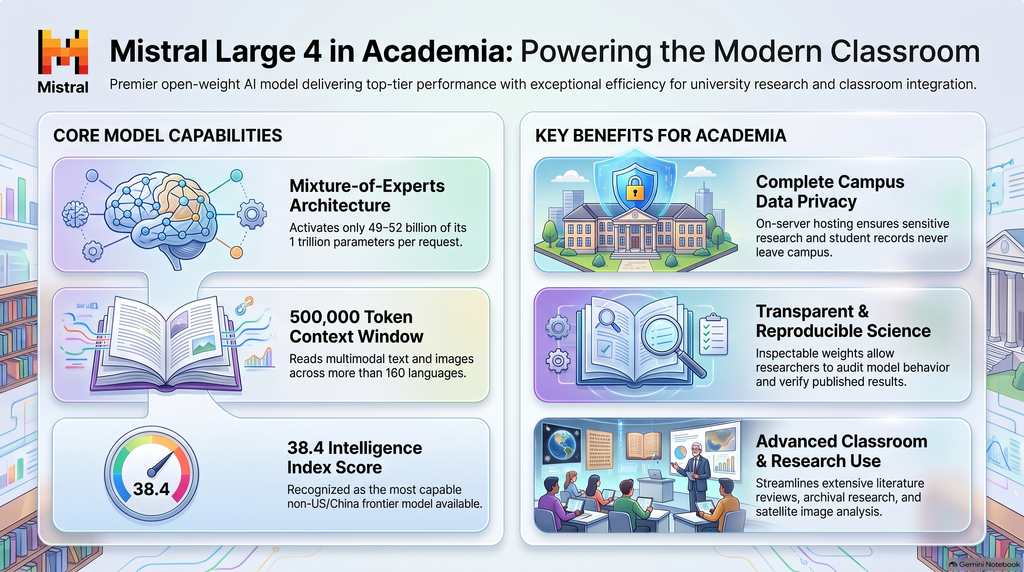
| On October 6, 2026, the French AI company Mistral AI released a preview of its new flagship model, Mistral Large 4 — affectionately nicknamed “Le Chonk” by the team (Mistral AI, 2026). VP of Science Pierre Stock celebrated the launch on LinkedIn, but what does the model actually do, and how does his excitement hold up against the facts? More importantly, should faculty and students care? What is Mistral Large 4? In simple terms, Large 4 is a very large AI model. It uses a “mixture-of-experts” design. Imagine a hospital where each token (piece of text) is sent only to the specialists it needs, instead of waking up every doctor on staff. That is why a model with about 1 trillion total parameters only “activates” roughly 49–52 billion of them for each request (Mistral AI, 2026; Tom’s Hardware, 2026). The result: frontier-level performance at a fraction of the running cost. The model reads both text and images, understands more than 160 languages (every official EU language among them), and can process extremely long documents — about half a million tokens in one go (Mistral AI, 2026). Does it live up to the hype? Mostly, yes — with honest caveats. Independent testers at Artificial Analysis gave Large 4 a score of 38.4 on their Intelligence Index, making it the most capable model from outside the US and China (Trending Topics, 2026). That is a remarkable jump: its predecessor, Large 3, scored only 9. It matches OpenAI’s GPT-6 Luna and is strongest in specialized areas like cybersecurity, where it scored 82% on CyberGym, ahead of GPT-6 Luna’s 78% (Tom’s Hardware, 2026). But here is the sobering part: among open-weight models, it would currently rank eighth — and all seven models ahead of it are Chinese (Trending Topics, 2026). It is also about four times more expensive per task than rivals like DeepSeek V4.1 Flash or GLM-5.3 Flash (Tom’s Hardware, 2026). What about Stock’s other claims? They check out. The model was trained from scratch on about 3,800 NVIDIA Grace Blackwell GPUs using only ~10 megawatts of power — remarkably lean for a frontier model (Mistral AI, 2026). And the €3 billion Series D round, announced September 8, 2026 at a valuation above €21 billion and led by Samsung, is confirmed as Europe’s largest tech fundraise ever (TechCrunch, 2026). One thing the LinkedIn post leaves out: the weights are not actually available yet. Mistral promises them by the end of October 2026, and until then the “open-weight” label is a promise, not a fact (Mistral AI, 2026). Why should academia care? Data privacy. Once the weights are downloadable, a university can run the model entirely on its own servers. Patient records, exam data, and confidential research never need to leave campus — a major advantage over closed tools like ChatGPT or Claude. Reproducible science. Open weights mean researchers can inspect how the model behaves, fine-tune it on their own data, and publish results others can verify. That is simply impossible with closed models. Multilingual and long-document work. With 160+ languages and a massive context window, Large 4 is well suited to literature reviews, archival research, comparative linguistics, and analysis of satellite imagery in geography and climate science (Mistral AI, 2026). Cost and honesty trade-offs. Closed American models still lead on general reasoning, and Chinese open models are cheaper and slightly ahead on several benchmarks (Trending Topics, 2026). Self-hosting also demands serious hardware — this is not a model for a laptop. The bottom line Mistral Large 4 is genuinely impressive: Europe’s strongest AI model, trained with striking energy efficiency, and backed by record funding. For universities that value privacy, reproducibility, and European data governance, it could become the model of choice — if Mistral delivers the open weights on time. Until then, treat the benchmarks as a promising preview, not the final word. | На 6 октомври 2026 г. френската AI компания Mistral AI пусна предварителна версия на новия си флагмански модел, Mistral Large 4 — наричан с обич от екипа „Le Chonk” (Mistral AI, 2026). Вицепрезидентът по науката Пиер Сток отпразнува излизането му в LinkedIn, но какво всъщност прави моделът и колко оправдано е вълнението му спрямо фактите? Още по-важно — трябва ли да се интересуват преподавателите и студентите? Какво е Mistral Large 4? С прости думи, Large 4 е много голям AI модел, който използва архитектура „смес от експерти” (mixture-of-experts). Представете си болница, в която всеки токен (частица текст) се изпраща само до специалистите, които му трябват, вместо да буди всички лекари. Затова модел с около 1 трилион общи параметри „активира” едва около 49–52 милиарда от тях за всяка заявка (Mistral AI, 2026; Tom’s Hardware, 2026). Резултатът: представяне на най-високо ниво на част от разходите. Моделът чете както текст, така и изображения, разбира повече от 160 езика (включително всеки официален език на ЕС) и може да обработва изключително дълги документи — около половин милион токена наведнъж (Mistral AI, 2026). Отговаря ли на очакванията? По-скоро да — с честни уговорки. Независими тестове от Artificial Analysis дадоха на Large 4 резултат 38,4 по техния Intelligence Index, което го прави най-способният модел извън САЩ и Китай (Trending Topics, 2026). Това е забележителен скок: предшественикът му, Large 3, получи едва 9 точки. Моделът изравнява GPT-6 Luna на OpenAI и е най-силен в специализирани области като киберсигурността, където постига 82% на теста CyberGym, пред GPT-6 Luna с неговите 78% (Tom’s Hardware, 2026). Но ето и трезвата част: сред моделите с отворени тежести той би заемал осмо място — и всичките седем модела пред него са китайски (Trending Topics, 2026). Освен това е около четири пъти по-скъп на задача от конкуренти като DeepSeek V4.1 Flash или GLM-5.3 Flash (Tom’s Hardware, 2026). А какво става с останалите твърдения на Сток? Потвърдени са. Моделът е обучен от нулата върху около 3800 графични процесора NVIDIA Grace Blackwell, използвайки само ~10 мегавата мощност — забележително икономично за модел от този клас (Mistral AI, 2026). А финансирането от €3 милиарда в раунд Series D, обявено на 8 септември 2026 г. при оценка над €21 милиарда и водено от Samsung, е потвърдено като най-голямото технологично набиране на средства в Европа досега (TechCrunch, 2026). Едно нещо обаче липсва в публикацията в LinkedIn: тежестите (weights) все още не са достъпни. Mistral обещава да ги пусне до края на октомври 2026 г., а дотогава етикетът „отворени тежести” е обещание, а не факт (Mistral AI, 2026). Защо академичната общност трябва да се интересува? Защита на данните. След като тежестите станат достъпни за изтегляне, университетът може да стартира модела изцяло на собствените си сървъри. Данните за пациенти, изпитите и конфиденциалните изследвания няма нужда да напускат кампуса — голямо предимство пред затворени инструменти като ChatGPT или Claude. Възпроизводима наука. Отворените тежести означават, че изследователите могат да инспектират как моделът се държи, да го дообучават със собствени данни и да публикуват резултати, които други могат да проверят. Със затворените модели това просто е невъзможно. Многоезична работа и дълги документи. С над 160 езика и огромен контекстен прозорец Large 4 е подходящ за прегледи на литературата, архивни изследвания, съпоставителна лингвистика и анализ на сателитни изображения в географията и климатичните науки (Mistral AI, 2026). Компромиси между цена и честност. Затворените американски модели все още водят по общо разсъждение, а китайските отворени модели са по-евтини и малко напред по няколко показателя (Trending Topics, 2026). Собственото хостване също изисква сериозен хардуер — това не е модел за лаптоп. Крайният извод Mistral Large 4 е наистина впечатляващ: най-силният европейски AI модел, обучен с изключителна енергийна ефективност, подкрепен от рекордно финансиране. За университети, които ценят поверителността, възпроизводимостта и европейското управление на данните, той може да стане моделът на избора — ако Mistral изпълни обещанието за отворени тежести навреме. Дотогава приемайте резултатите от тестовете като обещаващо визуализиране на бъдещето, а не като окончателната дума. |
References
Mistral AI. (2026, October 6). Introducing Mistral Large 4. https://mistral.ai/news/mistral-large-4/
TechCrunch. (2026, September 8). Mistral raises €3B as sovereign AI becomes big business. https://techcrunch.com/2026/09/08/mistral-raises-e3b-as-sovereign-ai-becomes-big-business/
Tom’s Hardware. (2026, October 9). Independent tests rank Mistral’s new trillion-parameter Large 4 the best AI model outside the U.S. and China. https://www.tomshardware.com/tech-industry/artificial-intelligence/independent-tests-rank-mistrals-new-trillion-parameter-large-4-the-best-ai-model-outside-the-u-s-and-china-but-chinese-open-weights-still-overcome-europes-best-efforts
Trending Topics. (2026, October 6). Mistral Large 4 on Artificial Analysis. https://www.trendingtopics.eu/mistral-large-4-artificial-analysis-ranking/