
Обучение по ИИ за професионално развитие на преподавателите: какво може да научи ИУ – Варна от международния опит
| Vodcast | Видео |
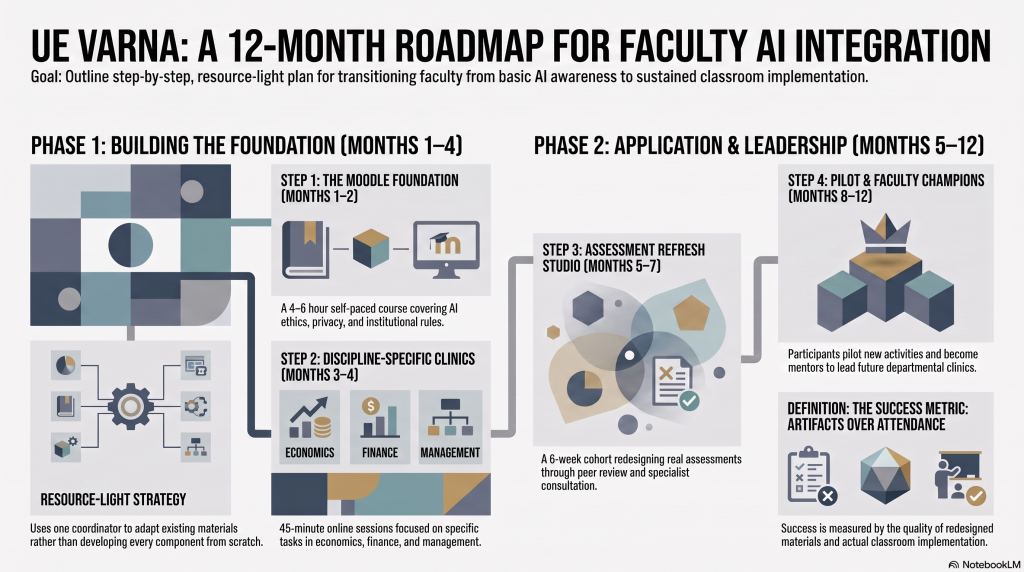
| The main finding from current global practice for effective faculty AI development promotes a combination of a short common foundation, applied course or assessment redesign, peer exchange, and follow-up evaluation. Tool demonstrations and isolated webinars help faculty become aware of AI, but they rarely produce sustained changes in teaching. For the University of Economics, Varna, the most feasible model is a Moodle-based foundation followed by a small redesign cohort and a faculty-champion network. This approach can operate with one training coordinator by sharing facilitation across librarians, information technology staff, experienced lecturers, external partners, and trained faculty mentors. What current faculty AI development looks like Faculty development has shifted from “how to use ChatGPT” toward AI literacy, professional judgment, assessment redesign, verification, data protection, accessibility, copyright, and discipline-specific application. UNESCO’s framework organizes teacher competence into five areas: human-centred practice, ethics, AI foundations, AI pedagogy, and AI-supported professional learning. Each develops through Acquire, Deepen, and Create levels. [1] This progression has regulatory relevance in Bulgaria. Article 4 of the EU AI Act requires organizations deploying AI systems to support staff AI literacy, taking account of experience, education, context, and affected groups. The obligation has applied since February 2025, with supervision and enforcement beginning in August 2026. The revised provision does not impose one universal proficiency level, so UE Varna can document a proportionate, role-sensitive programme rather than purchase a standard commercial certificate. [2] Across institutions, four delivery models recur: 1. Short asynchronous courses establish common knowledge. 2. Workshops develop skills through guided practice. 3. Cohort institutes require participants to redesign real 4. teaching materials. 4. Communities of practice distribute expertise and sustain implementation. The strongest programmes connect these formats. A self-paced course supplies the foundation, a workshop introduces application, a redesign studio produces a usable artifact, and a community supports classroom implementation. Comparable institutional models The following cases emphasize regional, teaching-focused, and resource-conscious institutions rather than expensive programmes at globally elite universities. 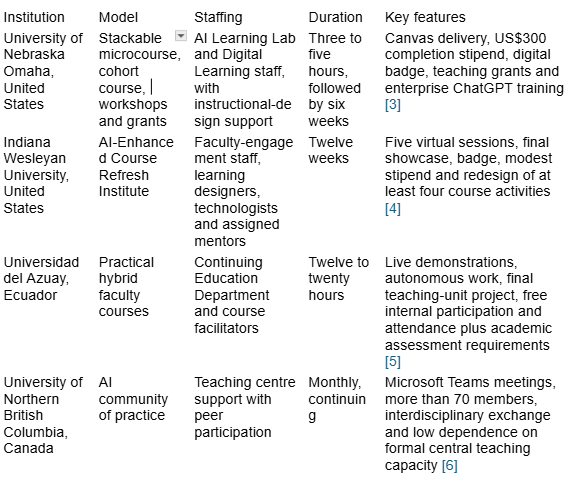 Reviewing these cases confirms the ability of UE Varna to manage the operation with a small AI center. The Center needs an organized pathway, reusable resources, clear assessment criteria, and distributed contributors. What the evidence supports The evidence remains stronger for participation, satisfaction and confidence than for student learning. A German study of 122 academics found four profiles: optimistic, critical, critically reflected, and neutral. About 79 percent expressed interest in AI training for teaching and learning, while preferred commitments commonly ranged from five to twenty hours. This finding supports differentiated routes rather than one compulsory workshop for everyone. [7] Indiana Wesleyan provides stronger evidence of practice transfer. Thirteen of fifteen initial participants completed its institute and redesigned at least four course activities. Mean satisfaction reached 4.9 out of 5, and all survey respondents intended to use the strategies in other courses. The sample remains small and does not establish student-learning effects, but the redesigned artifacts offer better evidence than attendance records. [8] A 2026 study at Universidad Alfonso X el Sabio followed 180 faculty members across two academic years. Reported AI awareness rose from 4.82 to 7.06, while 428 instructors completed its Level II certification and 660 attended practical workshops. Participants rated workshop usefulness at 9.1 out of 10. The study lacked a control group, so it demonstrates institutional progress and positive perceptions rather than causal impact on teaching quality. [9] A five-session faculty workshop pilot at Weill Cornell Medicine-Qatar also demonstrated feasibility and positive responses, but its ten-participant sample illustrates the wider evidence gap: few studies follow faculty into classrooms or measure student outcomes. [10] UE Varna should therefore assess three levels: faculty learning, quality of produced materials, and subsequent implementation. A resource-light strategy for UE Varna UE Varna already has a useful foundation. Its March and April 2026 programme offered daily 45-minute sessions and Moodle resources covering fact-checking, research tools, responsible AI use, assessment redesign, adult learning, microcredentials and Claude-based workflows. This existing programme should become the entry layer of a sustained pathway rather than remain a sequence of separate events. [11] During months one and two, the single coordinator should create a four to six-hour Moodle foundation. Modules should cover AI concepts, verification, privacy, copyright, bias, accessibility, institutional rules, research integrity and permitted student use. The coordinator can adapt UNESCO materials and existing UE Varna workshop resources instead of developing every component. During months three and four, UE Varna should run repeated 45-minute online clinics. Each clinic can address one task from economics, finance, tourism, management or information technology. Examples include checking AI-generated market statistics, evaluating fabricated references, creating transparent research workflows, or revising an assignment that AI can complete without demonstrating learning. During months five to seven, a cohort of twelve lecturers should join a six-week Course and Assessment Refresh Studio. Each participant should produce one revised assessment, an AI-use statement, a student-facing AI-literacy activity, and a short implementation plan. Peer review can replace intensive individual consulting. The coordinator should invite, if available, a librarian, information technology colleague, quality-assurance representative and legal or data-protection specialist for one session each. During months eight and nine, participants should pilot their redesigned activities. During months ten to twelve, UE Varna should hold a showcase, publish approved examples in Moodle and recruit four to six participants as faculty champions. The champions can lead future departmental clinics and a monthly online community of practice. Existing Moodle, Google Meet and institutional productivity services can support the pilot. Free or institutionally available tools can include Zotero, ResearchRabbit, Elicit, Scite, approved general-purpose AI systems and local sandbox courses. A planning allocation of BGN 3,000 to BGN 6,000 would cover small faculty incentives, guest facilitation, limited paid-tool access and recognition materials. The university should avoid purchasing broad licences until the pilot identifies clear educational requirements. Success should mean more than registrations. UE Varna should use a pre-training diagnostic, a scenario-based post-test, an artifact rubric, and an eight-to-twelve-week implementation survey. End-of-semester evidence should include student understanding of AI rules, assessment quality, faculty workload, accessibility, reported incidents and examples where faculty deliberately chose not to use AI. This evaluation design would give the coordinator evidence for improving the program while building a distributed support structure. [1] Artificial Intelligence and Education Systems | International Institute for Capacity Building in Africa https://www.iicba.unesco.org/en/artificial-intelligence-and-education-systems?utm_source=chatgpt.com [2] AI talent, skills and literacy | Shaping Europe’s digital future https://digital-strategy.ec.europa.eu/en/policies/ai-talent-skills-and-literacy?utm_source=chatgpt.com [3] AI Support | Division of Innovative and Learning-Centric Initiatives | University of Nebraska Omaha https://www.unomaha.edu/innovative-and-learning-centric-initiatives/ai-learning-lab/ai-support.php?utm_source=chatgpt.com [4] Advancing AI Literacy: A Faculty Course Refresh Institute at Indiana Wesleyan University | EDUCAUSE Review https://er.educause.edu/articles/2026/3/advancing-ai-literacy-a-faculty-course-refresh-institute-at-indiana-wesleyan-university [5] Inteligencia artificial en la educación superior: fundamentos, práctica responsable e implicaciones profesionales | Departamento Formación Continua UDA https://formacioncontinua.uazuay.edu.ec/cursos/inteligencia-artificial-educacion-superior-fundamentos-practica-responsable-implicaciones?utm_source=chatgpt.com [6] CTLT Supported Councils and Working Groups | UNBC https://www.unbc.ca/centre-teaching-and-learning/ctlt-supported-councils-and-working-groups?utm_source=chatgpt.com [7] Artificial intelligence in higher education: exploring faculty use, self-efficacy, distinct profiles, and professional development needs | International Journal of Educational Technology in Higher Education | Springer Nature Link https://link.springer.com/article/10.1186/s41239-024-00490-1?utm_source=chatgpt.com [8] Advancing AI Literacy: A Faculty Course Refresh Institute at Indiana Wesleyan University | EDUCAUSE Review https://er.educause.edu/articles/2026/3/advancing-ai-literacy-a-faculty-course-refresh-institute-at-indiana-wesleyan-university?utm_source=chatgpt.com [9] Analysis of teachers’ perceptions of the impact of Generative Artificial Intelligence in higher education | Journal of New Approaches in Educational Research | Springer Nature Link https://doi.org/10.1007/s44322-026-00060-5?utm_source=chatgpt.com [10] Design and Evaluation of a Faculty Development Workshop Series on Integrating Generative Artificial Intelligence in Medical Education: Mixed Methods Pilot Study – PMC https://pmc.ncbi.nlm.nih.gov/articles/PMC13148327/?utm_source=chatgpt.com [11] Workshops on AI in teaching and research – Икономически университет – Варна https://www.ue-varna.bg/bg/news/workshops-on-ai-in-teaching-and-research/4222 | Международният опит показва, че ефективното обучение на преподаватели по изкуствен интелект не може да се ограничи до демонстрации на ChatGPT или отделни уебинари. Успешните програми съчетават обща основа по грамотност в областта на ИИ, практическо преработване на учебни дейности и оценяване, обмен между колеги и проследяване на резултатите. За Икономически университет – Варна най-реалистичният подход е кратък базов курс в Moodle, последван от малка програма за обновяване на дисциплини и мрежа от преподаватели, които споделят опит. Подобен модел може да се координира от един служител, ако университетът разпредели част от дейностите между библиотекари, ИТ специалисти, преподаватели с опит, външни партньори и доброволни ментори. От работа с инструменти към професионална преценка Обучението по ИИ постепенно се измества от въпроса „Как да използваме ChatGPT?“ към по-важни теми: • проверка на генерирана информация; • защита на лични и институционални данни; • авторско право и академична почтеност; • пристрастия и ограничения на моделите; • достъпност; • промяна на оценяването; • отговорно използване на ИИ в преподаването и научните изследвания. Рамката на UNESCO за компетентности на преподавателите по ИИ включва пет области: ориентирани към човека практики, етика, основи на ИИ, педагогика с ИИ и използване на ИИ за професионално развитие. Компетентностите се развиват на три равнища: придобиване, задълбочаване и създаване (UNESCO, 2024). Тази тема има и нормативно значение. Член 4 от Европейския акт за изкуствения интелект изисква организациите, които внедряват системи с ИИ, да осигурят подходящо равнище на грамотност сред служителите, които работят с тях. Обучението трябва да отчита техния опит, образование, професионална роля и контекста на използване. За ИУ – Варна това означава, че университетът не се нуждае от еднакъв курс за всички. По-подходяща е система с различни равнища и направления според задачите на преподавателите и служителите (European Commission, 2026). Как обучават преподавателите други университети В международната практика се срещат четири основни модела: Кратки самостоятелни онлайн курсове за общи знания. Практически семинари за упражняване на конкретни умения. Кохортни програми, в които преподавателите преработват реални учебни материали. Общности за обмен на опит и взаимна подкрепа. Най-добрите програми свързват тези модели. Онлайн курсът дава общата основа. Работната среща показва конкретно приложение. Студиото за преработване на дисциплини води до завършен продукт. Общността от преподаватели подкрепя последващото прилагане. University of Nebraska Omaha предлага кратки курсове в Canvas, шестседмично обучение, дигитални сертификати, семинари и малки грантове за обновяване на преподаването. Моделът насочва участниците към разработване на учебни материали, вместо да измерва успеха само чрез присъствие (University of Nebraska Omaha, n.d.). Indiana Wesleyan University организира дванадесетседмичен AI-Enhanced Course Refresh Institute. Преподавателите участват в пет виртуални срещи, работят с ментори и преработват поне четири дейности от своя дисциплина. Тринадесет от първите петнадесет участници завършват програмата, а средната удовлетвореност достига 4,9 от 5 (Bleistein & Snyder, 2026). Universidad del Azuay в Еквадор предлага дванадесетчасови и двадесетчасови хибридни курсове. Те включват демонстрации, самостоятелна работа и финален проект, свързан с конкретна учебна единица. Този модел е подходящ за институции, които не разполагат с големи центрове за преподавателска квалификация (Universidad del Azuay, 2025). University of Northern British Columbia поддържа общност по ИИ с над 70 участници. Срещите се провеждат ежемесечно, а преподавателите обсъждат свои практики и проблеми. Подобна общност изисква ограничен централен ресурс, защото участниците постепенно поемат част от споделянето и подкрепата (University of Northern British Columbia, n.d.). Какво показват изследванията Проучване сред 122 университетски преподаватели в Германия установява четири профила на отношение към ИИ: оптимистичен, критичен, критично рефлективен и неутрален. Около 79% от участниците проявяват интерес към обучение за използване на ИИ в преподаването. Предпочитаната продължителност обикновено е между пет и двадесет часа (Mah & Groß, 2024). Този резултат подкрепя идеята за различни пътеки на обучение. Начинаещите имат нужда от основни понятия и безопасни упражнения. По-опитните преподаватели търсят подкрепа за оценяване, научни изследвания, анализ на данни и управление на работни процеси. Изследване в Universidad Alfonso X el Sabio проследява 180 преподаватели в рамките на две академични години. Самооценената им осведоменост за ИИ нараства от 4,82 на 7,06. Общо 428 преподаватели завършват второ равнище на сертификация, а 660 посещават практически семинари. Участниците оценяват полезността на семинарите с 9,1 от 10. Изследването не включва контролна група, затова показва институционален напредък и положителни нагласи, но не доказва пряк ефект върху качеството на обучението (Vivas-Urias, Obispo-Díaz, & Ruiz-Rosillo, 2026). Реалистична стратегия за ИУ – Варна ИУ – Варна вече има добра основа. Проведените през март и април 2026 г. ежедневни 45-минутни сесии разглеждат проверка на факти, изследователски инструменти, отговорно използване на ИИ, оценяване, обучение на възрастни, микроквалификации и работни процеси с Claude (University of Economics – Varna, 2026). Следващата стъпка е тези отделни събития да се превърнат в годишна програма. Съществуващите платформи Moodle и Google Meet, както и институционалните услуги за продуктивност и съвместна работа, могат да подкрепят пилотната инициатива. Сред безплатните или вече достъпните за университета инструменти могат да бъдат Zotero, ResearchRabbit, Elicit, Scite, одобрени универсални системи с изкуствен интелект и локални тестови курсове. Планиран бюджет между 1 500 и 3000 евро би могъл да покрие малки стимули за преподавателите, участието на гост-лектори и външни фасилитатори, ограничен достъп до платени инструменти и материали за признаване на участието и постиженията. Университетът трябва да избягва закупуването на широкообхватни лицензи, докато пилотната инициатива не установи ясно конкретните образователни потребности. През първите два месеца координаторът може да създаде базов курс в Moodle с продължителност от четири до шест часа. Модулите могат да обхванат основи на ИИ, проверка на резултатите, защита на данните, авторско право, пристрастия, достъпност, академична почтеност и правила за студентска употреба. През третия и четвъртия месец могат да се провеждат кратки онлайн практически сесии. Всяка сесия трябва да разглежда една задача от икономика, финанси, туризъм, управление или информатика. Примерите могат да включват проверка на генерирани пазарни данни, откриване на несъществуващи източници или преработване на задание, което ИИ изпълнява без студентът да демонстрира учене. От петия до седмия месец дванадесет преподаватели могат да участват в шестседмично студио за обновяване на дисциплини и оценяване. Всеки участник трябва да разработи: • едно преработено задание; • правила за използване на ИИ в дисциплината; • дейност за развиване на студентска грамотност по ИИ; • кратък план за прилагане и оценяване. Партньорската обратна връзка може да замени голяма част от индивидуалните консултации. Библиотекар, ИТ специалист, представител на звеното по качество и експерт по защита на данните могат да водят по една сесия. През следващите месеци участниците могат да изпробват разработените дейности, да представят резултатите си и да публикуват одобрените примери в Moodle. Четири до шест участници могат да станат преподаватели посланици и да подпомагат бъдещи обучения в своите катедри. Успехът не трябва да се измерва чрез броя регистрации. ИУ – Варна може да използва входяща диагностика, тест със сценарии, рубрика за оценяване на разработените материали и анкета осем до дванадесет седмици след обучението. Така един координатор ще получава данни за подобряване на програмата, без да носи сам цялата обучителна тежест. |
Bibliography
Anand, R., Bowers, N., and Manyama, M. F. “Design and Evaluation of a Faculty Development Workshop Series on Integrating Generative Artificial Intelligence in Medical Education.” JMIR Medical Education, 2026. https://doi.org/10.2196/89815
Bleistein, T., and Snyder, T. “Advancing AI Literacy: A Faculty Course Refresh Institute at Indiana Wesleyan University.” EDUCAUSE Review, 2026. https://er.educause.edu/articles/2026/3/advancing-ai-literacy-a-faculty-course-refresh-institute-at-indiana-wesleyan-university
European Commission. “AI Talent, Skills and Literacy.” 2026. https://digital-strategy.ec.europa.eu/en/policies/ai-talent-skills-and-literacy
Mah, D.-K., and Groß, N. “Artificial Intelligence in Higher Education: Exploring Faculty Use, Self-Efficacy, Distinct Profiles, and Professional Development Needs.” International Journal of Educational Technology in Higher Education, 21, 58, 2024. https://doi.org/10.1186/s41239-024-00490-1
UNESCO. AI Competency Framework for Teachers. Paris: UNESCO, 2024. https://unesdoc.unesco.org/ark:/48223/pf0000391104
Universidad del Azuay. “Artificial Intelligence as a Learning Tool in University Classrooms.” 2025. https://formacioncontinua.uazuay.edu.ec/en/cursos/inteligencia-artificial-como-herramienta-del-aprendizaje-las-aulas-universitarias
University of Economics, Varna. “Workshops on AI in Teaching and Research.” 2026. https://www.ue-varna.bg/bg/news/workshops-on-ai-in-teaching-and-research/4222
University of Nebraska Omaha. “AI Professional Development Opportunities.” https://www.unomaha.edu/innovative-and-learning-centric-initiatives/ai-learning-lab/ai-support.php
University of Northern British Columbia. “AI Community of Practice.” https://www.unbc.ca/centre-teaching-and-learning/ctlt-supported-councils-and-working-groups
Vivas-Urias, M. D., Obispo-Díaz, C., and Ruiz-Rosillo, M. A. “Analysis of Teachers’ Perceptions of the Impact of Generative Artificial Intelligence in Higher Education.” Journal of New Approaches in Educational Research, 15, 12, 2026. https://doi.org/10.1007/s44322-026-00060-5