
ИИ грамотност отвъд ChatGPT: Избор на правилния AI инструмент за правилната образователна потребност
| Podcast | Подкаст |
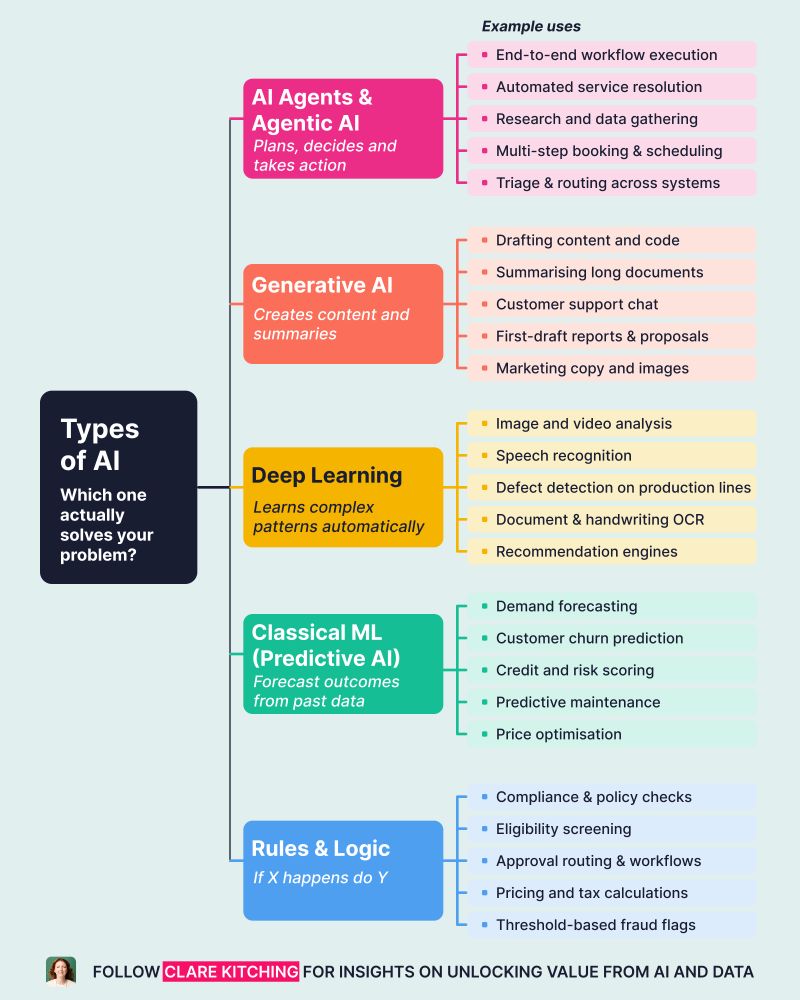
| AI is not the strategy. Business fit is. That is the core point in Clare Kitching’s LinkiedIn post, and the comments make the point even stronger. The infographic in her post reveals a simple hierarchy: Rules and Logic, Predictive, Deep Learning, Generative, and Agents. The value of the graphic lays in viewing AI as a menu, not as one big entity. A rule engine checks conditions. A predictive model estimates what may happen next. Deep learning helps with perception. Generative AI creates content. Agents take action across steps and systems. Recent research supports the ideas discussed in the LinkedIn post and comments. For example, NIST’s Generative AI Profile highlights that generative AI requires careful testing, monitoring, and verification because it can produce inaccurate or fabricated information (NIST, 2024). The EU AI Act also emphasizes AI literacy and human oversight, especially when AI systems influence important decisions (European Union, 2024). This is not only a business issue. It is also relevant for universities. If a university wants to check whether an application contains all required documents, a simple rules-based system may be enough. If it wants to identify students who may need academic support, predictive analytics may be more appropriate. If instructors need help drafting feedback or summarizing materials, generative AI can help. If AI systems begin making changes across multiple university systems, such as enrollment, scheduling, or student records, stronger governance and human oversight become necessary. The comments under Clare Kitching’s post repeatedly return to the same conclusion: organizations often rush toward generative AI and AI agents because they appear innovative, even when simpler solutions would solve the problem more effectively. It is not about universities needing less AI. It is about finding the right type of AI for the right problem at the institution. This is particularly important because considering the widespread use of AI among students. A recent HEPI survey reports 92% of students use AI tools and 88% use generative AI for assessment-related activities, while only 36% reported receiving AI skills training from their institution (Freeman, 2025). At the same time, the EDUCAUSE Horizon Report notes a large number of higher education institutions are still developing policies, practices, and staff capabilities for responsible AI adoption (EDUCAUSE, 2024). Kitching’s post and the discussion in regard to academia boils down to the following: start with the problem, not the technology. Choose the least complex solution that meets the need. Build AI literacy alongside verification skills. Keep human judgment at the center. As AI systems become more autonomous, governance, accountability, and oversight become increasingly important. References EDUCAUSE. (2024). 2024 EDUCAUSE Horizon Report: Teaching and Learning Edition. https://library.educause.edu/resources/2024/5/2024-educause-horizon-report-teaching-and-learning-edition European Union. (2024). Regulation (EU) 2024/1689 Artificial Intelligence Act. https://eur-lex.europa.eu/eli/reg/2024/1689/oj/eng Freeman, J. (2025). Student Generative AI Survey 2025. Higher Education Policy Institute (HEPI). https://www.hepi.ac.uk/2025/02/26/student-generative-ai-survey-2025/ National Institute of Standards and Technology (NIST). (2024). Artificial Intelligence Risk Management Framework: Generative Artificial Intelligence Profile (AI 600-1). https://nvlpubs.nist.gov/nistpubs/ai/NIST.AI.600-1.pdf Kasneci, E., Sessler, K., Küchemann, S., Bannert, M., Dementieva, D., Fischer, F., Gasser, U., Groh, G., Günnemann, S., Hüllermeier, E., Krusche, S., Kutyniok, G., Michaeli, T., Nerdel, C., Pfeiffer, F., Poquet, O., Sailer, M., Schmidt, A., Seidel, T., Stadler, M., & Kasneci, G. (2024). ChatGPT for good? On opportunities and challenges of large language models for education. Learning and Individual Differences, 103, 102274. https://doi.org/10.1016/j.lindif.2023.102274 | Изкуственият интелект не е стратегията. Стратегията е намирането на правилното решение за конкретния проблем. Това е основната идея в публикацията на Клеър Китчинг в LinkedIn: Коментарите под публикацията допълнително засилват това послание. Инфографиката представя проста йерархия на различните видове AI: Правила и логика, Предиктивни модели, Дълбоко обучение, Генеративен AI и AI агенти. Стойността на тази схема е, че разглежда изкуствения интелект като набор от различни инструменти, а не като една единствена технология. Системите, базирани на правила, проверяват условия. Предиктивните модели прогнозират какво може да се случи. Дълбокото обучение подпомага разпознаването и възприятието. Генеративният AI създава съдържание. Агентите изпълняват действия в различни системи и процеси. Съвременни изследвания подкрепят идеите, обсъждани както в публикацията, така и в коментарите. Например профилът на NIST за генеративен AI подчертава необходимостта от внимателно тестване, наблюдение и проверка на генеративните системи, тъй като те могат да създават неточна или напълно измислена информация (NIST, 2024). Законът на Европейския съюз за изкуствения интелект също поставя акцент върху AI грамотността и човешкия контрол, особено когато AI системите участват във вземането на важни решения (European Union, 2024). Това не е само бизнес въпрос. Темата е изключително актуална и за университетите. Ако университетът иска да провери дали кандидат-студент е приложил всички необходими документи, проста система, базирана на правила, може да бъде напълно достатъчна. Ако целта е да се открият студенти, които имат нужда от допълнителна академична подкрепа, предиктивният анализ може да бъде по-подходящо решение. Ако преподавателите се нуждаят от помощ при изготвяне на обратна връзка, резюмета или учебни материали, генеративният AI може да бъде полезен. Ако обаче AI системите започнат да извършват промени в студентски досиета, графици или административни системи, стават необходими по-сериозно управление, отчетност и човешки надзор. Коментарите под публикацията на Клеър Китчинг многократно стигат до едно и също заключение: организациите често се насочват директно към генеративен AI и AI агенти, защото изглеждат иновативни, дори когато по-прости решения биха решили проблема по-ефективно. Въпросът не е дали университетите имат нужда от повече или по-малко AI. Въпросът е да изберат правилния вид AI за конкретния проблем. Това е особено важно предвид широкото разпространение на AI сред студентите. Според проучване на HEPI от 2025 г. 92% от студентите използват AI инструменти, а 88% използват генеративен AI за дейности, свързани с оценяване и учебни задачи. В същото време едва 36% посочват, че са получили обучение по AI умения от своята институция (Freeman, 2025). Докладът EDUCAUSE Horizon Report също отбелязва, че много висши училища все още разработват политики, практики и капацитет за отговорно внедряване на AI (EDUCAUSE, 2024). За академичната общност посланието на публикацията и последвалата дискусия може да бъде обобщено по следния начин: започнете с проблема, а не с технологията. Изберете най-простото решение, което отговаря на конкретната нужда. Развивайте AI грамотност заедно с умения за проверка и оценка на информацията. Поставяйте човешката преценка в центъра на процеса. Колкото по-автономни стават AI системите, толкова по-важни стават управлението, отчетността и човешкият контрол. Използвана литература EDUCAUSE. (2024). 2024 EDUCAUSE Horizon Report: Teaching and Learning Edition. https://library.educause.edu/resources/2024/5/2024-educause-horizon-report-teaching-and-learning-edition European Union. (2024). Regulation (EU) 2024/1689 Artificial Intelligence Act. https://eur-lex.europa.eu/eli/reg/2024/1689/oj/eng Freeman, J. (2025). Student Generative AI Survey 2025. Higher Education Policy Institute (HEPI). https://www.hepi.ac.uk/2025/02/26/student-generative-ai-survey-2025/ National Institute of Standards and Technology (NIST). (2024). Artificial Intelligence Risk Management Framework: Generative Artificial Intelligence Profile (AI 600-1). https://nvlpubs.nist.gov/nistpubs/ai/NIST.AI.600-1.pdf Kasneci, E., Sessler, K., Küchemann, S., Bannert, M., Dementieva, D., Fischer, F., Gasser, U., Groh, G., Günnemann, S., Hüllermeier, E., Krusche, S., Kutyniok, G., Michaeli, T., Nerdel, C., Pfeiffer, F., Poquet, O., Sailer, M., Schmidt, A., Seidel, T., Stadler, M., & Kasneci, G. (2024). ChatGPT for good? On opportunities and challenges of large language models for education. Learning and Individual Differences, 103, 102274. https://doi.org/10.1016/j.lindif.2023.102274 |