
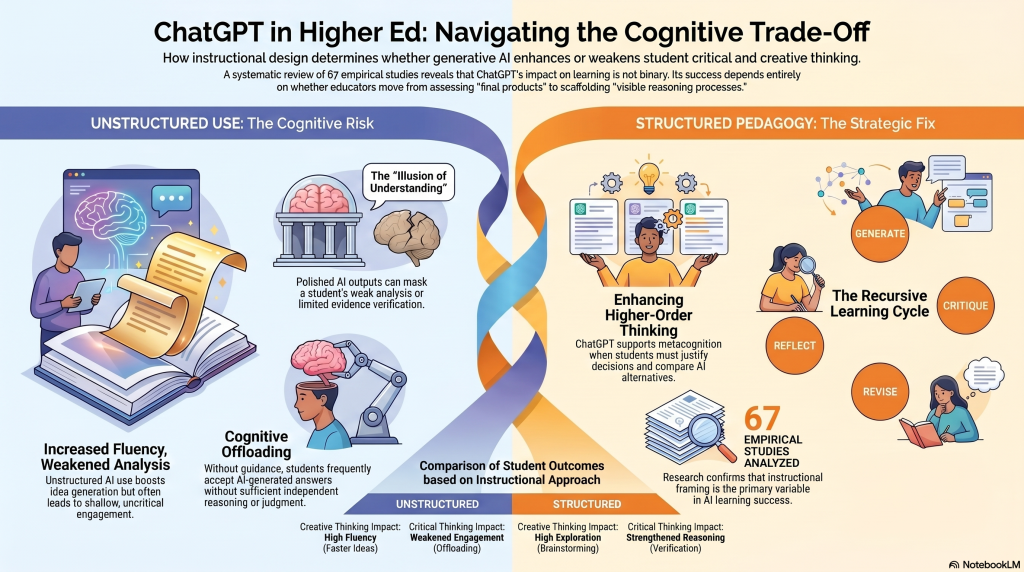
A systematic review of 67 studies reveals that generative AI acts as a double-edged sword for student cognition, significantly impacting critical and creative thinking based on how it is utilized. While the technology can accelerate idea generation, it often leads to cognitive offloading and superficial reasoning if students use it without proper guidance. The research emphasizes that instructional design is the primary factor in determining whether AI enhances or hinders learning outcomes. To prevent a decline in independent analysis, educators must shift their focus from final products to the visible reasoning process. Ultimately, the study suggests that pedagogical scaffolding and recursive learning cycles are essential for turning AI into a tool for higher-order thinking. Success in the modern classroom depends on fostering AI literacy and redesigning assessments to prioritize reflection over polished outputs.
Listen to podcast (21 min)
A new systematic review examining 67 empirical studies on ChatGPT in higher education offers one of the clearest pictures so far of generative AI impact on student thinking. The findings challenge both extremes in current debates. ChatGPT neither automatically improves learning nor automatically weakens it. Its cognitive impact depends heavily on instructional design, task structure, and educators’ ability to frame AI use in learning environments.
One of the most important observations from the review is the distinction between critical thinking and creative thinking. The authors distinguish between critical thinking, which focuses on evaluation and judgment, and creative thinking, which focuses on idea generation and exploration. Evidence suggests that ChatGPT can improve one domain while weakening the other when instructional guidance is limited.
When educators structure AI-supported activities around inquiry, reflection, argumentation, and revision, ChatGPT can support both domains simultaneously. Students showed improvements in metacognitive regulation, evaluative reasoning, brainstorming, and idea generation. The strongest results appeared in courses where students had to critique AI outputs, compare alternatives, verify information, and justify decisions.
ChatGPT can strengthen or weaken critical and creative thinking depending on whether educators design learning around reflection, verification, argumentation, and structured cognitive engagement.
The review also identifies a more concerning pattern. In many unstructured learning contexts, ChatGPT increased creative fluency while weakening critical engagement. Students generated ideas faster and produced more polished work, but they often accepted AI-generated outputs without sufficient evaluation. Researchers repeatedly observed cognitive offloading, shallow reasoning, and reduced independent analysis.
Many current assessments still reward polished final products instead of visible reasoning processes. ChatGPT’s fluency creates the illusion of understanding. A well-written answer can hide weak analysis, limited verification, or superficial engagement with evidence. The real challenge is no longer detecting AI use. The challenge is redesigning learning and assessment for thinking to remain visible.
The authors repeatedly return to the importance of instructional scaffolding. ChatGPT worked best when educators designed recursive learning cycles: generate, critique, revise, reflect. It performed poorly when students used it passively as a shortcut for task completion. AI literacy also emerged as a major factor. Students with stronger prompting, verification, and reflection skills were more likely to maintain critical engagement while benefiting from AI-supported creativity.
ChatGPT supports higher-order thinking only when institutions redesign pedagogy around process, reflection, and epistemic responsibility. Universities should move beyond debates focused only on cheating detection and instead develop assessment models to evaluate reasoning, revision, judgment, and interaction with AI systems. The future of AI in education depends less on the technology itself and more on educators’ ability to structure learning around it.
Li, C., Cui, H., & Hagedorn, L. S. (2026). The cognitive impact of ChatGPT in higher education: A systematic review of critical and creative thinking outcomes. Computers and Education: Artificial Intelligence, 10, 100571. https://doi.org/10.1016/j.caeai.2026.100571
ChatGPT и когнитивният компромис между критическото и творческото мислене
Ново систематично обзорно изследване, анализиращо 67 емпирични проучвания за ChatGPT във висшето образование, предлага една от най-ясните до момента картини за въздействието на генеративния ИИ върху студентското мислене. Резултатите поставят под въпрос и двете крайни позиции в настоящите дебати. ChatGPT нито автоматично подобрява ученето, нито автоматично го отслабва. Неговото когнитивно въздействие зависи в голяма степен от instructional design, структурата на задачите и способността на преподавателите да рамкират използването на ИИ в учебна среда.
Едно от най-важните наблюдения в обзора е разграничението между критическо и творческо мислене. Авторите разглеждат критическото мислене като процес, свързан с оценяване и преценка, а творческото мислене като процес, свързан с генериране на идеи и изследване на възможности. Данните показват, че ChatGPT може да подобрява едната когнитивна област, докато отслабва другата, когато липсва достатъчно педагогическо насочване.
Когато преподавателите структурират дейности с подкрепа от ИИ около изследване, рефлексия, аргументация и редакция, ChatGPT може да подкрепя едновременно и двете области. Студентите показват подобрения в метакогнитивната регулация, оценъчната аргументация, мозъчната атака и генерирането на идеи. Най-силни резултати се наблюдават в курсове, в които студентите трябва да критикуват отговорите на ИИ, да сравняват алтернативи, да проверяват информация и да аргументират решенията си.
Обзорът идентифицира и по-притеснителен модел. В много неструктурирани учебни контексти ChatGPT увеличава творческата плавност, но отслабва критическата ангажираност. Студентите генерират идеи по-бързо и създават по-полирани текстове, но често приемат генерираните от ИИ отговори без достатъчна оценка. Изследователите многократно наблюдават когнитивно разтоварване, повърхностно разсъждение и намален самостоятелен анализ.
ChatGPT може да засили или отслаби критическото и творческото мислене в зависимост от това дали преподавателите структурират ученето около рефлексия, проверка, аргументация и целенасочена когнитивна ангажираност.
Много от настоящите форми на оценяване все още възнаграждават добре оформения краен продукт вместо видимия процес на мислене. Плавността на ChatGPT създава илюзия за разбиране. Добре написан отговор може да прикрива слаб анализ, ограничена проверка или повърхностно ангажиране с доказателства. Истинското предизвикателство вече не е откриването на използване на ИИ. Предизвикателството е преработването на ученето и оценяването така, че мисленето да остане видимо.
Авторите многократно подчертават значението на instructional scaffolding. ChatGPT работи най-добре, когато преподавателите проектират рекурсивни цикли на учене: генериране, критика, редакция, рефлексия. Резултатите са значително по-слаби, когато студентите използват ИИ пасивно като преход към по-бързо изпълнение на задачите. AI literacy също се очертава като ключов фактор. Студентите с по-добри умения за създаване на подкани, проверка и рефлексия са по-склонни да запазят критическата си ангажираност, докато се възползват от подкрепената от ИИ креативност.
ChatGPT подкрепя висшите когнитивни умения само когато институциите преработят педагогиката около процеса, рефлексията и епистемичната отговорност. Университетите трябва да излязат отвъд дебатите, фокусирани единствено върху откриването на измама, и вместо това да разработят модели за оценяване, които измерват аргументация, редакция, преценка и взаимодействие с ИИ системи. Бъдещето на ИИ в образованието зависи по-малко от самата технология и повече от способността на преподавателите да структурират ученето около нея.
Li, C., Cui, H., & Hagedorn, L. S. (2026). The cognitive impact of ChatGPT in higher education: A systematic review of critical and creative thinking outcomes. Computers and Education: Artificial Intelligence, 10, 100571. https://doi.org/10.1016/j.caeai.2026.100571